-
Project members Dr Daniele Di Mitri, Nina Mouhammad (DIPF), Stefan Hummel (DIPF), Jan Schneider (DIPF), Roland Klemke (CGL), Melina Rose (CGL)
-
Funded by German Federal Ministry of Research, Technology and Space (BMFTR)
-
Date 09/2022 - 08/2025
-
Funding amount EUR 750,000
About
HyTea — Model for Hybrid Teaching (www.hytea.de) was a collaborative research project funded by the German Federal Ministry of Education and Research (former BMBF - now BMFTR) with a total budget of €750,000. The project brought together the EduTec gec group at DIPF | Leibniz Institute for Research and Information in Education in Frankfurt and the Cologne Game Lab at TH Köln – University of Applied Sciences . Running from September 2022 through the end of 2025, HyTea investigated how AI-based software can support learners in designing and delivering more effective presentations
The challenge
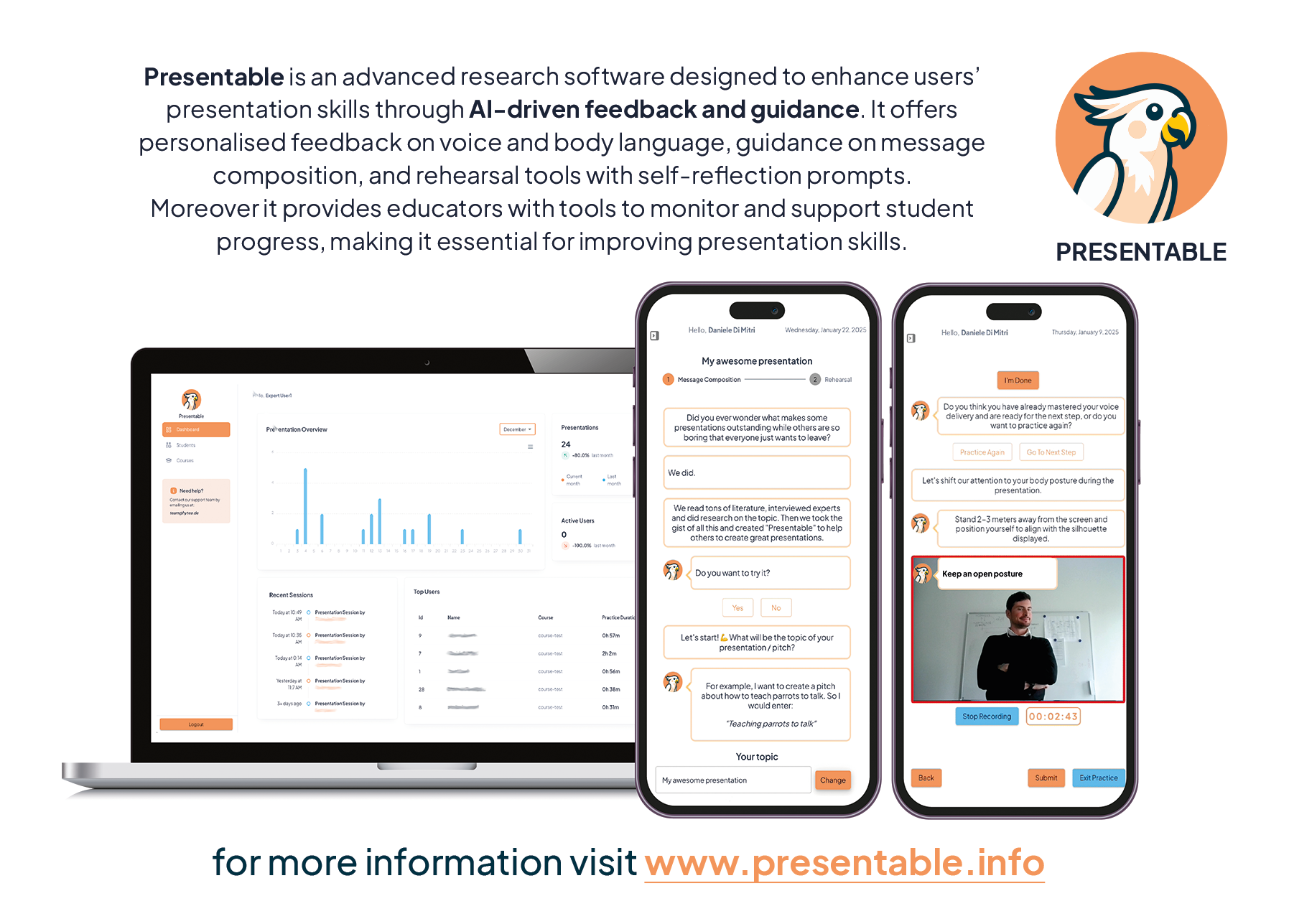
Effective presentation training traditionally requires the presence of a human expert — a resource that is not always available, scalable, or consistent. At the same time, AI systems deployed in educational settings risk generating feedback that, while technically accurate, may not align with human pedagogical values, contextual norms, or learning goals — a problem known as the alignment problem. HyTea addressed both challenges simultaneously: making high-quality, expert-level presentation training accessible at scale, while ensuring that the AI systems driving it remained transparent, accountable, and aligned with the judgment of human educators. The project's most tangible outcome is Presentable, an educational software tool that translates HyTea's research into a working application. Presentable enables learners to practice presentation skills and receive automated, multimodal AI-driven feedback, embodying the project's core commitment to pedagogically sound and human-aligned AI design.
-
Approach
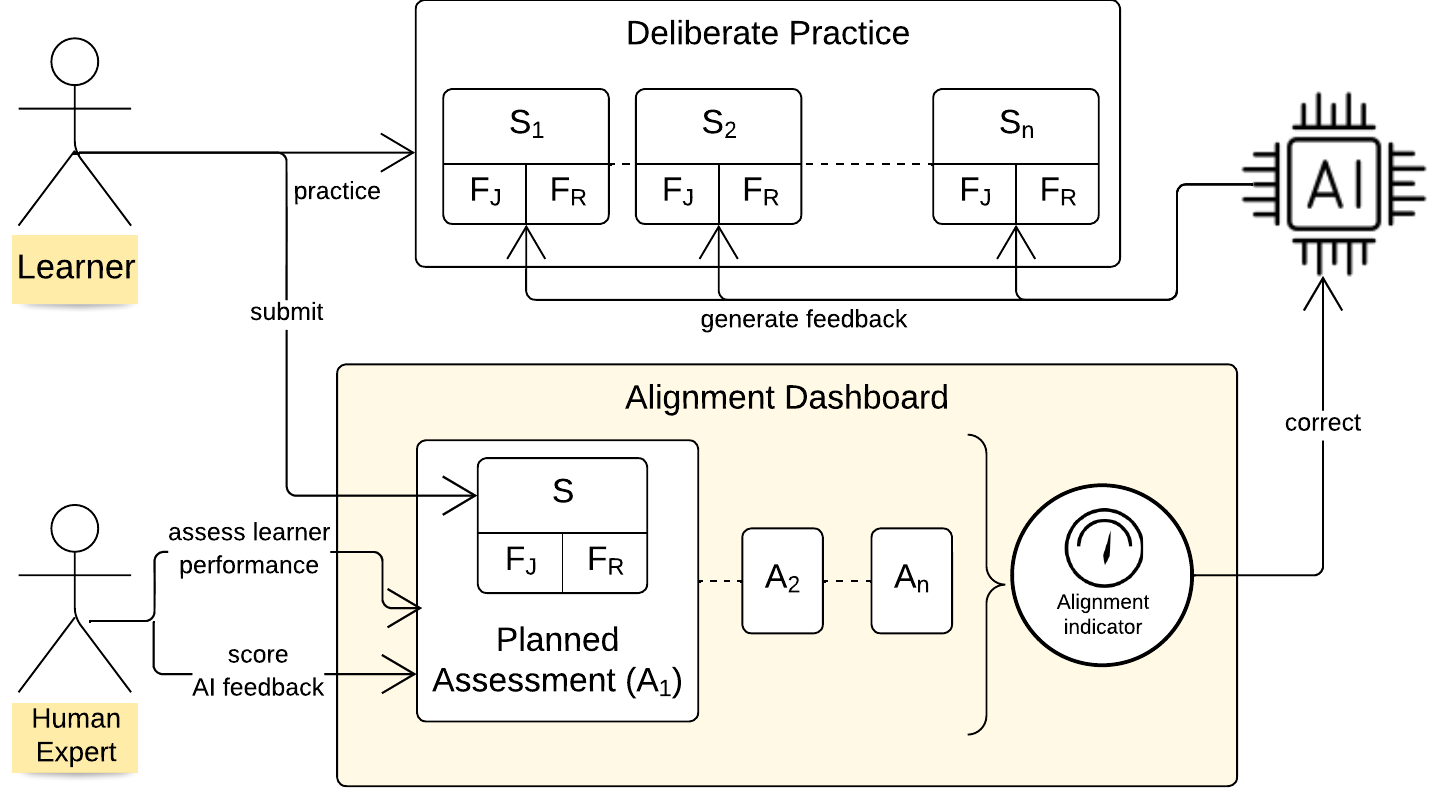
Approach HyTea designed Presentable — an AI-driven system capable of providing real-time, personalised feedback on a range of presentation skills, including body posture, use of pauses, and voice intonation. Presentable allows learners to practice autonomously in engaging, low-stakes environments. To keep human educators in the loop, the system included an Alignment Dashboard that allowed teachers to asynchronously monitor learner progress, evaluate AI-generated feedback, and verify its alignment with learning objectives.
-
Outcomes
HyTea produced both scientific and practical results across its three-year duration. Research contributions advanced the understanding of automated feedback for presentation skills, multimodal learning analytics, and value-aligned AI design in educational contexts. The project also generated reusable design frameworks and datasets to inform future work at the intersection of AI, immersive technologies, and education. The project's most tangible outcome is Presentable, an educational software tool that translates HyTea's research into a working application. Presentable provides learners with personalized AI-driven feedback on voice and body language, guidance on message composition, and rehearsal tools with self-reflection prompts — while equipping educators with dashboards to monitor and support student progress.
-
Members
HyTea was led by two Principal Investigators: Dr. Daniele Di Mitri (DIPF) and Prof. Dr. Roland Klemke (Cologne Game Lab, TH Köln). The project financed three PhD candidates — two at DIPF and one at Cologne Game Lab. Dr. Jan Schneider contributed as a postdoctoral expert with extensive experience in presentation training software research, while Nina Mouhammad pursued her doctoral work on message composition skills and was responsible for AI feedback on verbal communication and the teacher dashboard. Stefan Hummel pursued his PhD on improving the acceptance of presentation training software.